
What is Dupuytren’s Contracture
Dupuytren’s contracture is named after Baron Guillaume Dupuytren, the French surgeon who first described it in 1831.
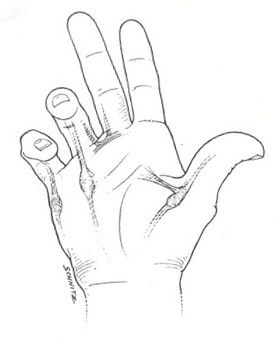
Your hands have a strong layer of tissue just under the skin that helps protect your palm and supports finger movement. This tissue connects to your fingers and helps them bend and grip.
In a condition called Dupuytren’s contracture, this tissue slowly tightens and thickens. Over time, it can pull one or more fingers—usually the ring and little fingers—into a bent position. You may also notice small lumps in your palm or thickened skin near your finger joints. This usually happens gradually and is not typically painful, but it can make it harder to straighten your fingers or use your hand normally.
Doctors don’t fully know what causes this condition. It is more common in people with Northern European backgrounds and can run in families. It tends to affect men in their 50s and women in their 60s.
Some factors are linked to a higher chance of developing the contracture, including repeated hand use, past hand or wrist injuries, diabetes, epilepsy, alcohol use, carpal tunnel syndrome, and trigger finger.
If you notice your fingers becoming harder to straighten or feel lumps in your palm, it’s a good idea to talk to a your primary care provider to discuss treatment options.
There is no proven Hand Therapy treatment to prevent or slow the progression of the condition.
TREATMENT AFTER SURGERY
It is important to see a hand therapist for treatment after surgery to help you restore your hand function. Following any surgery, scar tissue is laid down to provide the healing. This scar tissue, if left alone will shorten and prevent the fingers from fully straightening. If the joints have been bent for a long time, they will be stiff.
Treatment may include a combination of orthosis/splint use (usually worn at night for four to six months), scar pressure, heat, hand exercises, joint mobilization, scar massage, ultrasound, etc..